
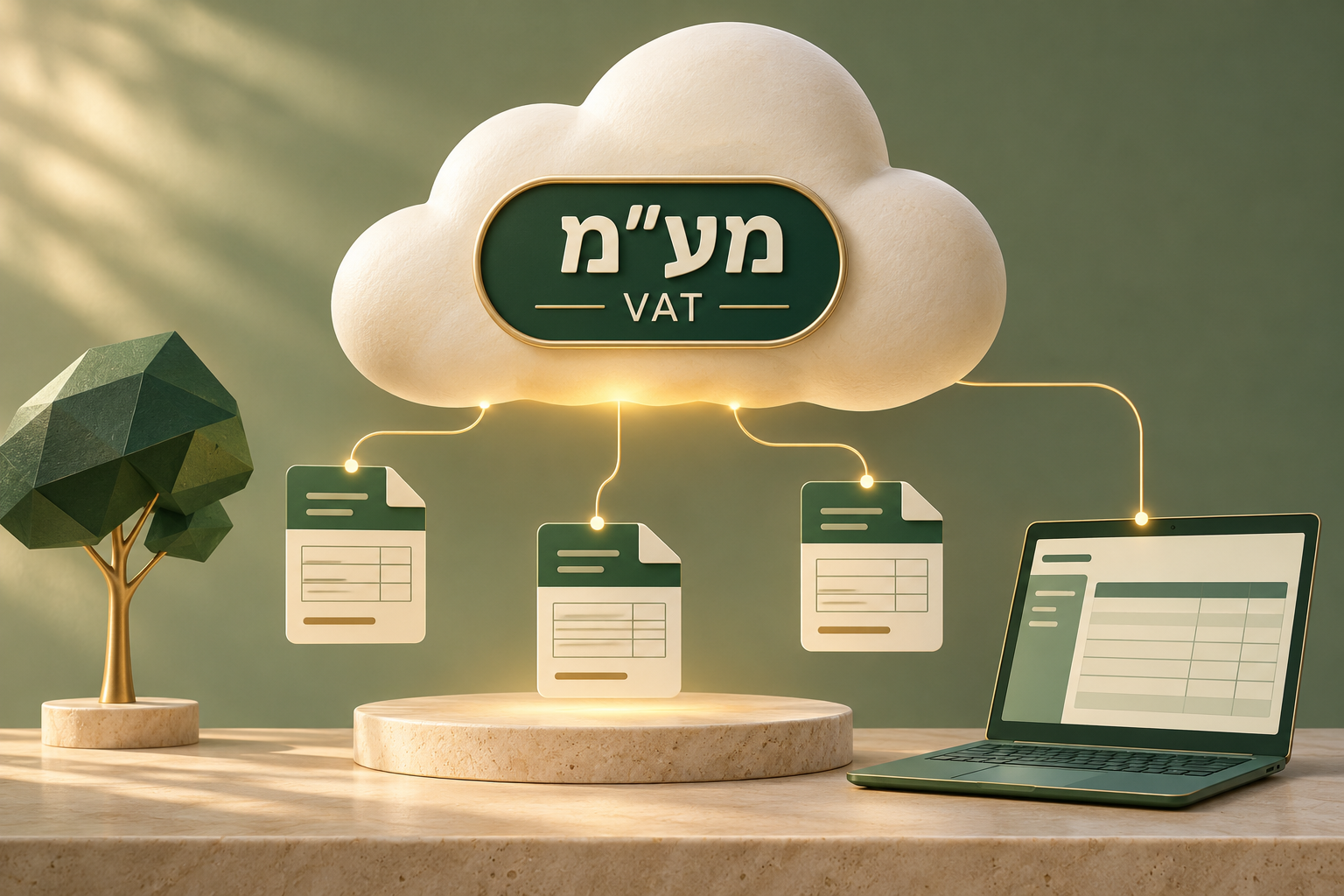
The vision: invoices reach the system, without another reminder
Imagine a business owner no longer searching through email, WhatsApp and the glove compartment for an invoice at month-end. A supplier creates a digital document, information flows between authorised systems, and the business and its accountant see an organised picture. We see this as a worthwhile direction: less copying and forwarding, with more time to understand the figures.
This is our professional vision for the coming year, through November 2027. It is not an announcement that a government system already replaces every invoice and return.
What already exists — and what does “online VAT” mean?
Israeli VAT returns and payments can already be handled online. The Israel Invoices model also allows invoice allocation numbers to be obtained through connected software or a Tax Authority application. These existing digital processes do not establish that every invoice is stored in a government cloud and automatically entered in a business ledger.
In August 2026, Globes reported on a developing proposal called “Israel Invoices 2.0 — Online VAT”, involving continuous invoice-data flows and changes to VAT payments. The report describes a proposed reform for 2027, subject to legislation and implementation decisions. It should not be treated as confirmation that the changes are already in force.
Will everything sit in an “income tax cloud”?
The relevant body is the Israel Tax Authority, which administers VAT as well as other taxes. Our cloud vision is about connected systems: invoicing software, bookkeeping platforms and authority services exchanging information under defined rules and permissions. It does not necessarily mean one government folder replacing every system.
An allocation number or data transmission is not the same as transferring a complete document with all its business context. Even where the authority has data, the business still needs to ensure that the required documents and information reach its bookkeeping system and are retained as required.
What could everyday work look like a year from now?
In the scenario we hope to see, invoices from compatible systems would flow into bookkeeping more continuously, reducing manual forwarding. Connected tools could help with reconciliation and highlight missing documents, credit notes or duplicate entries. The professional team would handle exceptions and assess the substance of each transaction.
The useful shift would be from “Have you sent every invoice?” to “We need to understand this expense before filing.” Progress depends on legislation, standards, permissions, software and data quality. There is no certainty that this vision will be fully realised by November 2027.
A small everyday example
Suppose a supplier issues an invoice to a business. In a future connected workflow, the document and its details might reach the business system directly, without the owner forwarding another file to the accountant. But if the purchase is partly private, or a credit note has been issued, someone still needs to establish the facts and record the correct treatment. This is a fictional example of a possible workflow, not an automated service already available to every business.
What will the cloud not replace?
Technology can shorten the route information takes. It cannot, by itself, determine whether an expense belongs to the business, whether a document is valid or whether input VAT can be deducted. Reporting periods, payment reconciliation and unusual transactions also need appropriate review.
If the timing of VAT transfers to the state changes in future, businesses will need to review their cash-flow arrangements under the rules adopted. Until then, current reporting, payment and record-keeping obligations continue to apply. A forecast or news report is not a reason to stop providing documents.
How can businesses prepare now?
Use suitable, up-to-date software; organise documents in an agreed channel; review access permissions and backup arrangements; and tell your accountant about unusual transactions, credit notes and mixed business/private use. Even in a digital workflow, agree who reviews the data and who approves the return.
Our approach is straightforward: work towards a future with less invoice chasing, while preserving responsibility for the figures. A digital office, a personal connection — with technology serving the business.
Prepared on 2 November 2026. This article distinguishes existing services, a news report and the firm’s outlook. It does not establish a binding reform date or replace professional review of the obligations applying to a particular business.