
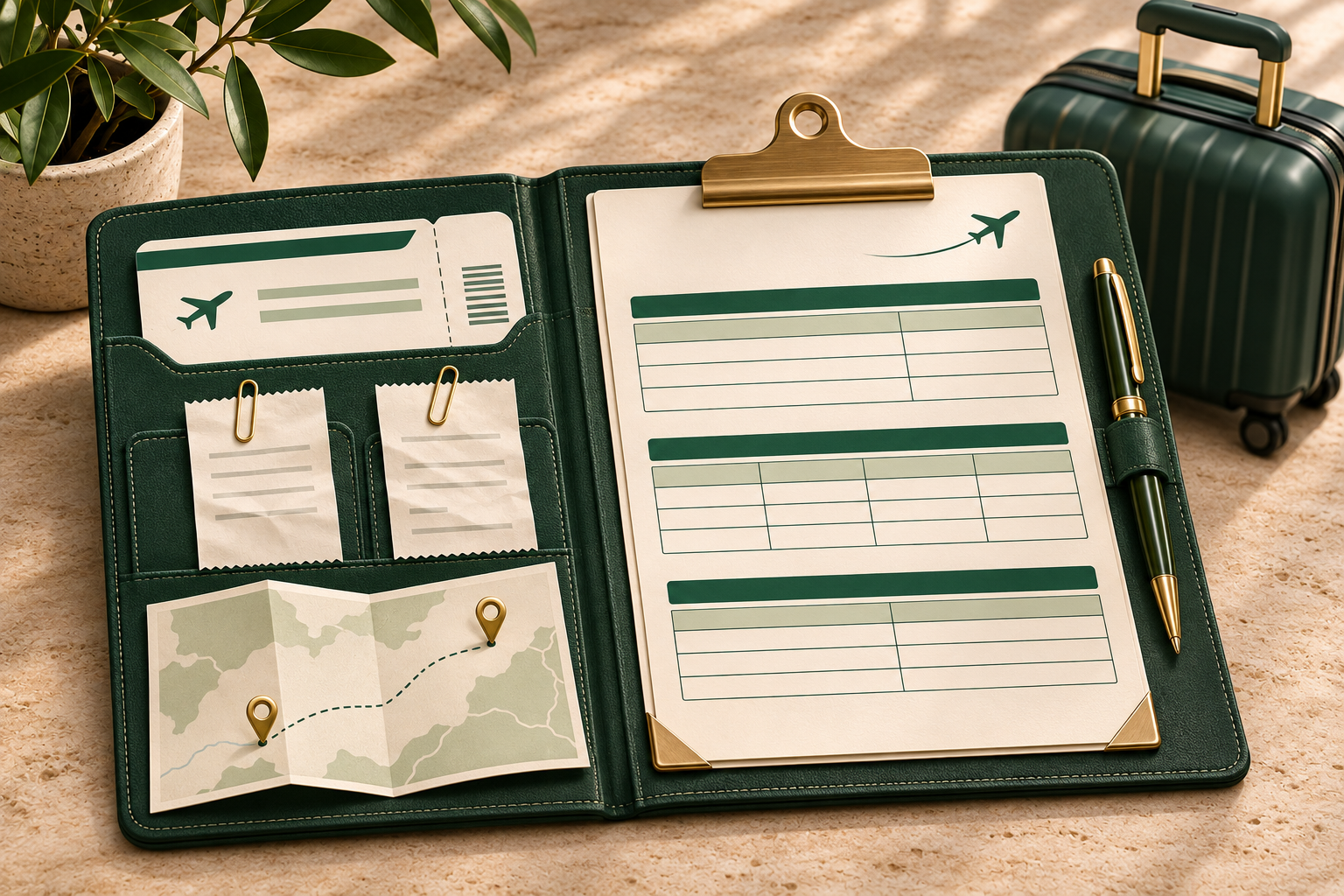
A flight receipt and hotel bill are a starting point. A useful report connects the business purpose, activities and costs so each item can be reviewed for business relevance and tax deductibility.
1. Why prepare a travel report?
It brings the itinerary and supporting documents together. It does not automatically establish a tax deduction or replace supplier invoices or the annual tax return. This guide offers a recommended working structure, rather than a standard Israel Tax Authority form. Tax treatment depends on the connection to earning income, the evidence and the rules for each expense.
2. What goes at the top of the report?
Record the business or company name and identification number; the traveller’s name and role; destination countries and cities; departure and return dates and times; the route and nights at each destination. Describe the purpose specifically: who you met, which conference you attended or what work you performed, and how it relates to the business. “Business trip” alone is not a sufficient explanation.
3. How should you record the days abroad?
Keep a short dated activity log: location, activity, business contact and supporting document. Identify working days, transit, waiting days and private days separately. A weekend within a trip needs a facts-based review; it is not automatically business or private. Record any holiday extension and accompanying family members, and separate their costs. Do not assume one allocation percentage suits every expense.
Example activity entry: 12 June — Berlin — meeting a supplier to assess equipment for the business — meeting invitation and professional notes attached. Illustrative only; no client information.
4. How should you list expenses?
Use one line per expense, following the fields below. Separate flights, accommodation, local transport, car rental, conferences and other costs. Identify whether the business, employee or a client paid, and who received any reimbursement. Include advances, cancellations, credits and airline or hotel refunds to avoid recording an expense or reimbursement twice.
Recommended expense-line fields
- Expense date
- Supplier and business description
- Category and destination
- Original amount and currency
- Shekel amount and conversion method
- Payer and payment method
- Business / private allocation
- Document reference, credit or refund
5. Which supporting documents should you attach?
- Flights: the invoice or receipt, e-ticket and itinerary; also keep a boarding pass or other available evidence that travel took place.
- Accommodation: the final itemised hotel bill showing guest and stay dates, rather than a reservation alone.
- Transport and car rental: receipts, rental agreement and charge breakdown.
- Conferences: invoice, registration confirmation and programme.
- Business purpose: relevant meeting invitations, correspondence or attendance evidence.
- A card statement supports payment but usually does not establish on its own what was purchased or why.
6. What about foreign currency or a missing receipt?
Keep the original amount and currency and the actual shekel charge where available. Record the exchange-rate source and conversion date under the reporting method agreed with the office; do not select an arbitrary rate. Request a duplicate from the supplier if a document is missing and flag the gap. Do not create a substitute supplier receipt or assume a bank transaction screenshot establishes deductibility.
7. Is the full amount deductible, and what about VAT?
Not necessarily. Even a documented business expense may be subject to limits or special rules. Review the travel year, destination, expense type and number of nights; this guide therefore does not provide a table of 2026 monetary limits. Some categories allow prescribed calculation methods beyond actual receipts, but these do not create an automatic per-diem entitlement. Foreign tax on an overseas invoice is not, by itself, Israeli input VAT and should not automatically be claimed in an Israeli VAT return. Any foreign-tax refund is assessed separately.
8. How do you finalise and send the report?
Reconcile totals to receipts and payments, deduct credits and identify private costs. For a company, reconcile employee advances and reimbursements and obtain approval under company policy; reimbursing an employee and receiving a tax deduction are different questions. Add the report date, traveller’s name and confirmation, and keep a digital file linking each expense line to its supporting document. Send it through an agreed channel rather than a public form. Extended stays or working overseas may require additional tax, residence and National Insurance review.
Before you send: a quick checklist
- Traveller, destinations and dates are complete.
- Business purpose and activity log include private days.
- Each expense has evidence or a clearly flagged missing document.
- Currencies, payers, advances and refunds are reconciled.
- Private costs are separated; tax deductibility will be reviewed by the office.
General information reviewed on 9 November 2026. Individual treatment depends on the facts and applicable rules. Document checklists are practical recommendations; evidence requirements vary by expense.